
FDA Makes Yeast Validation Rules Binding




On July 12, 2026, the US FDA issued final guidance titled Yeast Propagation Process Validation for Automated Bioreactors, turning several validation items in automated yeast propagation into binding compliance requirements. The change matters for integrated solutions involving Yeast Propagation & Dry Hopping and Fully Automatic CIP Stations because it directly affects validation scope, supporting documentation, and submission expectations at the process and equipment interface. For manufacturers, integrators, buyers, and compliance teams, the immediate point is not only what must now be validated, but also how process data and cleaning validation records may need to move together in review and delivery workflows.
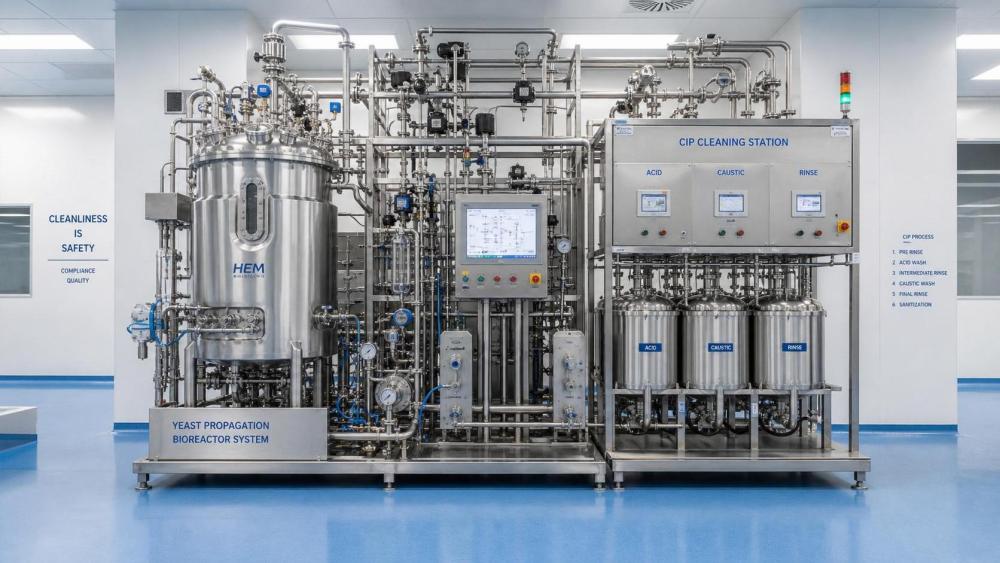
What the FDA guidance now requires
According to the provided event information, the US FDA released the final guidance on July 12, 2026, under the title Yeast Propagation Process Validation for Automated Bioreactors. The guidance newly places temperature gradient control, DO/ppb stability, and CO₂ purge efficiency within the mandatory validation scope for yeast propagation processes. It also requires supporting CIP cleaning validation data to be submitted at the same time. The guidance applies to integrated equipment solutions for Yeast Propagation & Dry Hopping and Fully Automatic CIP Stations, and it took effect immediately upon release.
Where the compliance pressure is likely to surface first
Equipment builders and system integrators face a tighter validation interface
From an industry perspective, suppliers involved in automated bioreactors, yeast propagation modules, and connected CIP systems are likely to feel the change first because the guidance links process validation more closely with cleaning validation evidence. The practical impact may appear in equipment qualification files, functional validation packages, technical documentation provided to customers, and specification alignment for integrated delivery. What deserves closer attention is whether existing document sets clearly support temperature gradient control, DO/ppb stability, CO₂ purge efficiency, and synchronized CIP validation submission.
Buyers and project owners may need to review procurement terms
Procurement teams and project owners may be affected because validation scope now appears broader at the point where process performance and cleaning assurance meet. Analysis shows that purchasing decisions, acceptance criteria, and delivery documentation expectations may need to reflect the new mandatory validation elements. In practice, buyers should pay closer attention to whether tenders, technical attachments, and supplier qualification reviews ask for complete validation support rather than treating process and CIP evidence as separate follow-up items.
Compliance and quality teams may see added pressure on submission readiness
For regulatory, quality, and validation teams, the impact is likely to center on submission readiness and internal document coordination. Because the guidance requires CIP cleaning validation data to be submitted together with the relevant process validation package, companies may need tighter control over how records are organized, reviewed, and released. Observably, this is less about a new standalone filing category than about a stricter expectation that connected validation evidence be available in a coordinated form.
After-sales and service providers may be drawn into traceability demands
Service teams and support providers may also be affected where post-installation tuning, maintenance, cleaning procedures, or validation support influence the documented state of an automated system. Analysis shows that the issue is not only commissioning performance but also whether service interventions leave a traceable basis for maintaining the required validation posture across process control and CIP operation.
What companies should watch in current execution
Check whether validation files reflect the newly mandatory parameters
Companies involved in design, procurement, commissioning, or compliance review should first examine whether existing validation packages explicitly address temperature gradient control, DO/ppb stability, and CO₂ purge efficiency. Where these points were previously handled as internal engineering metrics or supporting operating indicators, it is more appropriate to understand them now as items that may require clearer formal validation treatment.
Prepare for linked review of process and CIP records
What deserves closer attention is the guidance requirement that supporting CIP cleaning validation data be submitted simultaneously. Companies should therefore review whether process validation records and CIP validation records are maintained in a way that supports joint review, rather than being split across separate teams or delivery stages. If documentation remains fragmented, compliance response time and delivery coordination could become more difficult.
Revisit procurement, technical, and bid documents
Analysis shows that contracts, technical bid materials, equipment specifications, and factory acceptance documentation may need to be checked for alignment with the updated validation scope. This is especially relevant where integrated Yeast Propagation & Dry Hopping solutions or Fully Automatic CIP Stations are supplied as part of a broader project package. The current event information does not provide detailed enforcement mechanics, so the immediate task is document readiness rather than assuming a uniform market practice has already formed.
Keep tracking official wording and market interpretation
Because the guidance is already effective, companies should monitor how its wording is reflected in customer requirements, review expectations, qualification checklists, and market-facing technical submissions. Observably, the provided information confirms the binding scope and immediate effect, but it does not define every downstream execution detail. That makes follow-up monitoring of interpretation and implementation especially important.
Why this reads as an execution signal, not just a policy update
Analysis shows that this development is better understood as a live compliance signal rather than a distant policy direction. The key reason is that the guidance is final, binding, and effective immediately, while also expanding the validation boundary to include named process-control parameters and synchronized CIP evidence. At the same time, it would be premature to present downstream market effects as settled fact, because the provided information does not specify how different buyers, reviewers, or supply chains will apply the requirement in practice. For now, the more defensible reading is that the rule change has landed, while its operational interpretation still deserves close observation.
How the market should read the change for now
The immediate significance of this FDA action lies in the shift from general process control expectations to explicit mandatory validation points within automated yeast propagation systems, coupled with concurrent CIP validation submission. For affected market participants, this is not merely a technical note; it may influence compliance preparation, procurement review, delivery documentation, and service traceability. It is more appropriate to understand this event as an already effective rule change with practical implementation consequences, while keeping a neutral view on how quickly execution standards will stabilize across projects and counterparties.
Basis of this article and what still needs verification
This article is generated from the user-provided news title, event date, and event summary. For developments of this type, commonly relevant source categories may include official regulatory announcements, publications issued by supervisory authorities, trade or customs authority notices, industry association updates, standard-setting documents, and reporting by authoritative media. A specific official source link was not provided in the input, so that part still requires follow-up verification. Further observation is also needed on detailed implementation language, certification and validation interpretation, changes in tender documents, market feedback, and how companies execute against the guidance in practice.
Related News
- 00
0000-00
Contamination Control in Fermentation: Building a CIP and Sampling Plan That Works - 00
0000-00
How to Evaluate a Keg Dispensing Systems Supplier for Multi-Tap Draft Operations - 00
0000-00
How Isobaric Filling Technology Protects Beer Carbonation and Reduces Oxygen Pickup - 00
0000-00
How to Specify Bottle Filling Lines for Carbonated Drinks Without Sacrificing Fill Accuracy - 00
0000-00
How to Specify Turnkey Brewery Automation for Consistent Batch Quality and Labor Savings
Weekly Insights
Stay ahead with our curated technology reports delivered every Monday.