
RO Water Systems Draw Buyer Focus at Shenzhen Expo




On June 16, 2026, the opening day of the 12th Shenzhen International Cross-Border E-Commerce Fair showed that RO brewing water systems had become the most watched beer-equipment category among Southeast Asian buying groups. More than 127 technical inquiries were submitted on site by distributors from Indonesia, Vietnam, and Thailand, with attention centered on TDS removal stability, modular installation fit, and configuration for local water conditions. For exporters, equipment manufacturers, distributors, and brewery-facing service providers, this is worth close attention because it points to a purchasing discussion that is moving beyond price and toward water-treatment reliability in actual market use.
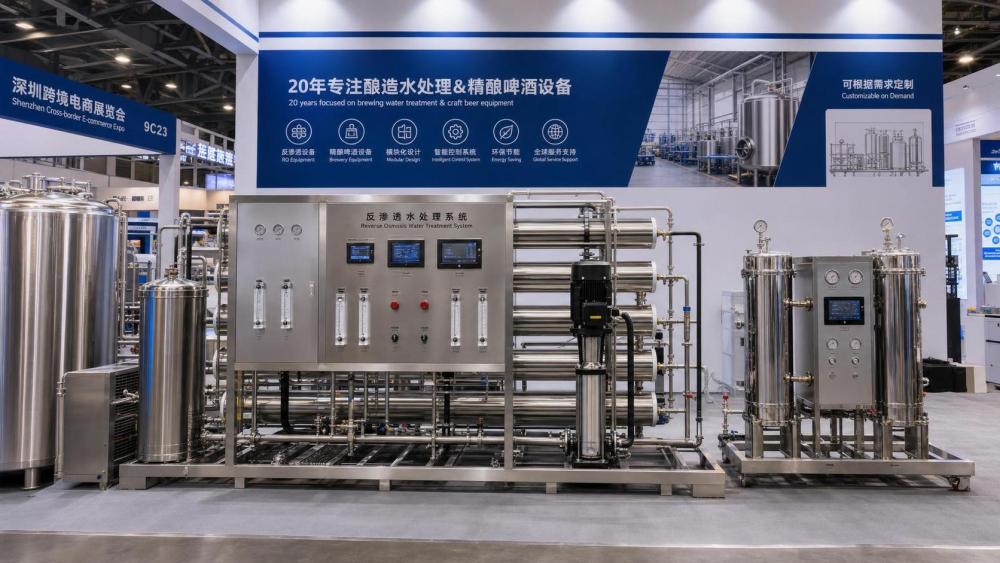
What the first-day data confirmed
The confirmed information is limited but clear. During the 12th Shenzhen International Cross-Border E-Commerce Fair, held from June 16 to 18, 2026, first-day data showed that RO brewing water systems were the category receiving the highest level of attention from Southeast Asian procurement groups.
According to the event information provided, distributors from Indonesia, Vietnam, and Thailand submitted more than 127 technical inquiries at the fair. The main issues raised were the stability of TDS removal rates, the adaptability of modular installation, and whether system configurations could match local water-quality conditions.
At the same event, a white paper on craft brewing water treatment in Southeast Asia was released. It stated that fluctuations in municipal water hardness in the region have led to a 37% increase in failure rates for traditional softening equipment.
Why this matters across the beer-equipment chain
For equipment manufacturers, product evaluation is becoming more technical
From an industry perspective, manufacturers may be affected because buyer attention is concentrating on performance consistency and deployment fit rather than only on basic treatment capability. The business impact is most likely to show up in specification design, technical documentation, and product communication, especially where buyers ask for evidence around stable TDS control and adaptation to different water conditions.
For distributors, local suitability becomes a sales issue
Distributors in Southeast Asia appear to be screening products through a local-application lens. Analysis shows that the key influence here is on product selection, customer-facing positioning, and after-sales preparation. What deserves closer attention is whether systems can be presented as modular and compatible with variable municipal water conditions, since those points were directly reflected in the inquiries.
For cross-border trade and delivery teams, customization pressure may rise
Companies handling export transactions and project delivery may see pressure in quotation, technical clarification, and order-conversion stages. Observably, when buyers focus on configuration compatibility, communication around product scope, documentation, and delivery content can become more detailed. That raises the importance of aligning technical and commercial discussions early in the sales process.
For brewery-facing service providers, water quality is moving closer to operations risk
The white paper detail about higher failure rates in traditional softening equipment suggests that service providers supporting breweries may need to pay more attention to how water-treatment choices connect to operating stability. This does not prove a market shift on its own, but it does indicate that local water variability is part of the purchasing conversation.
What companies should watch next
Track how technical claims are expressed
Companies should pay close attention to how buyers continue to frame questions around TDS removal stability. In practice, this affects technical presentations, bid responses, and customer communication. The issue is not simply whether a system is labeled as RO, but how clearly its performance stability is described in a way buyers can evaluate.
Prepare for market-specific configuration discussions
The inquiry focus on local water compatibility suggests that standard product messaging may not be enough in conversations with buyers from Indonesia, Vietnam, and Thailand. What deserves closer attention is whether teams are ready to explain configuration logic for differing water conditions without overstating confirmed capabilities.
Review modular installation readiness in delivery planning
Because modular installation fit was one of the main concerns raised at the fair, companies involved in sales and fulfillment should watch for follow-up requests tied to installation methods, integration scope, and deployment conditions. This is especially relevant in the handoff from business development to technical support and delivery coordination.
Separate event signals from confirmed commercial outcomes
Analysis shows that a high volume of technical inquiries is a meaningful market signal, but it is not the same as confirmed orders or completed projects. Companies should therefore distinguish between buyer interest, technical screening, and actual procurement decisions when assessing next steps.
How this signal should be read
Observably, this development says less about a broad market conclusion and more about what current buyer priorities look like in a specific export setting. The concentration of attention on RO brewing water systems, together with the white paper's note on municipal water hardness volatility, suggests that water-treatment reliability is being discussed as an operational issue rather than as a secondary equipment feature.
It is more appropriate to understand this as a near-term market signal with longer-term implications worth tracking. The information shows where buyer questions are clustering today, but it does not yet establish a final competitive outcome or a settled demand trend across the whole region.
A practical reading of the exhibition takeaway
The main industry meaning of this event lies in the structure of demand being expressed: buyers are asking technical questions tied to local operating conditions, not only making general category inquiries. For exporters and equipment-related businesses, the takeaway is not that the market has already shifted decisively, but that technical fit, modularity, and water-quality compatibility may now play a more visible role in cross-border discussions around brewing water systems.
At this stage, it is most appropriate to read the news as a concrete but still developing signal. It merits continued attention because it highlights how procurement dialogue is being framed, while leaving the eventual scale and persistence of that demand open to further verification.
Basis of this report
This article is based on the user-provided news title, event date, and event summary concerning the 12th Shenzhen International Cross-Border E-Commerce Fair on June 16, 2026. The specific official source link was not provided in the input, so the details should continue to be verified against any available official event releases, company statements, industry association materials, authoritative media reporting, or relevant technical publications that may emerge later.
Where continued observation is needed, the main follow-up direction is whether subsequent official event disclosures or related market communications provide more clarity on inquiry conversion, technical specification trends, or further discussion of local water-quality compatibility in Southeast Asia.
Related News
- 00
0000-00
How to Specify an Isobaric Filling Line for Carbonated Beverage Quality and Throughput - 00
0000-00
Contamination Control in Fermentation: Building a CIP and Sampling Plan That Works - 00
0000-00
How to Evaluate a Keg Dispensing Systems Supplier for Multi-Tap Draft Operations - 00
0000-00
How Isobaric Filling Technology Protects Beer Carbonation and Reduces Oxygen Pickup - 00
0000-00
How to Specify Bottle Filling Lines for Carbonated Drinks Without Sacrificing Fill Accuracy
Weekly Insights
Stay ahead with our curated technology reports delivered every Monday.