




Reverse osmosis can reduce dissolved salts, but it does not by itself ensure hygienic water delivery throughout a brewery. Downstream design determines whether quality survives.
For technical evaluators assessing hygienic process systems water treatment, the critical questions extend to storage tank design, distribution loop circulation, drainability, and validated cleaning procedures.
Poorly specified downstream components can compromise treated water before it reaches brewing, rinsing, or other quality-critical operations, even when the RO unit meets its specification.
The strongest procurement approach defines water quality at each point of use, then requires evidence that storage, distribution, sanitation, and monitoring consistently maintain that quality.
What Water Quality Must Each Brewery Operation Receive?
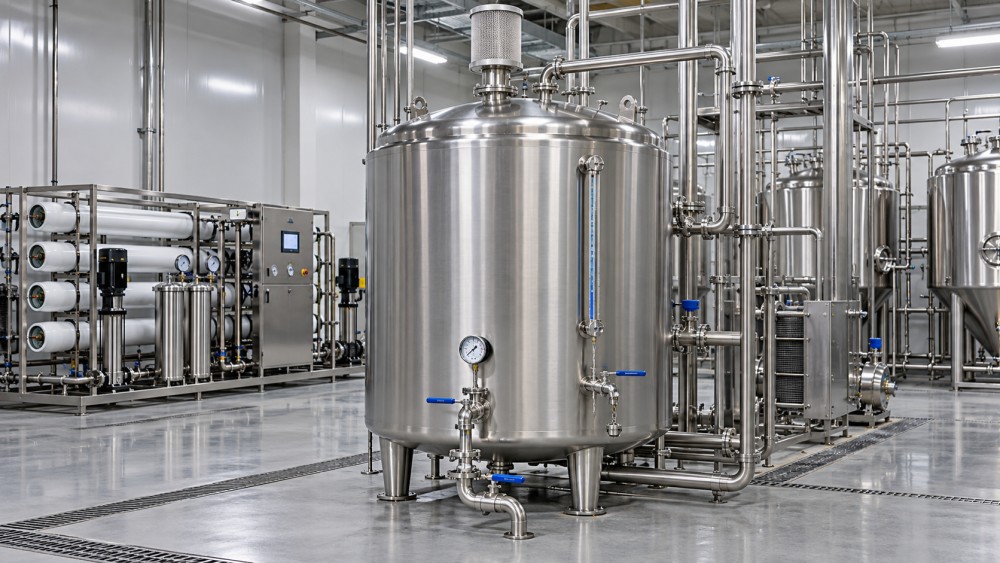
Begin with a point-of-use requirements matrix. Brewing liquor, packaging rinse water, CIP makeup, and boiler feed have different chemical, microbiological, and operational requirements.
Brewing liquor needs controlled mineral composition for mash performance and flavor consistency. Low conductivity alone cannot demonstrate suitability, especially when recipes require deliberate remineralization.
Water entering a kettle may encounter a subsequent thermal process. Water contacting cleaned packaging or cold product equipment may have no comparable downstream microbial reduction.
That distinction changes treatment priorities. Evaluate the exposure pathway, contact time, product susceptibility, and subsequent processing before specifying microbial limits or final treatment barriers.
Define numerical acceptance criteria where justified, including conductivity, hardness, alkalinity, chlorine or chloramine, and microbiological parameters. Identify the sampling method and location for each criterion.
Also specify temperature, pressure, instantaneous flow, and daily demand. Water meeting laboratory specifications still fails its purpose when insufficient pressure disrupts a critical rinse cycle.
Potable source water provides a baseline where required, but brewery process needs can be more demanding. Confirm applicable local drinking-water and food-processing requirements separately.
For every use, document who owns the specification and corrective action. Undefined responsibility between utilities, brewing, packaging, and quality teams often leaves practical control gaps.
Where Can Contamination Enter After Reverse Osmosis?
RO membranes provide a separation barrier, but the complete installation includes seals, housings, instruments, tanks, and connections. Their condition influences the quality delivered downstream.
Pretreatment also affects hygiene. Carbon filtration can remove disinfectant residuals, while poorly maintained media beds or softeners can introduce microbial loading ahead of the membranes.
After RO, nutrients may be limited, but microbial growth remains possible. Storage surfaces, stagnant branches, ambient temperatures, and maintenance openings can support contamination and biofilm development.
A conductivity reading cannot resolve that risk. Conductivity indicates ionic content; it does not demonstrate microbiological control or reliably detect every organic contaminant of concern.
Map contamination pathways from pretreatment through the final connection. Include tank vents, overflow lines, sample valves, dosing equipment, bypasses, flexible hoses, and maintenance access points.
Pay particular attention to cross-connections with untreated water or chemical systems. Backflow protection must match the hazard and local requirements, with accessible inspection and testing provisions.
Ask suppliers to explain how off-specification water is contained. Startup flushing, sanitation recovery, alarm handling, and diversion arrangements should appear in the operating philosophy.
Will the Storage Tank Remain Cleanable During Real Operation?
A treated-water tank buffers demand, but it also adds residence time and wetted surface area. Oversizing can increase stagnation without improving useful production resilience.
Size storage against measured demand profiles, RO recovery capacity, planned downtime, and sanitation requirements. Evaluate low-production periods as carefully as peak packaging shifts.
Specify a drainable vessel with accessible inspection points and internal geometry compatible with the selected cleaning method. Avoid pockets around fittings, outlets, and instrument connections.
The vent must accommodate filling and withdrawal while controlling contamination. Where microbial retention is required, specify suitable filtration, condensate management, maintenance access, and integrity verification.
Vent filtration does not replace pressure and vacuum protection. Confirm that protective devices remain effective under maximum transfer rates and foreseeable filter restriction conditions.
Require evidence that the cleaning device reaches relevant internal surfaces. Coverage testing can identify missed areas, but coverage alone does not prove soil removal or sanitization.
Level instruments, spray devices, and overflow arrangements need the same hygienic review as the vessel shell. A polished tank cannot compensate for an inaccessible contaminated fitting.
Does the Distribution Loop Control Stagnation at Every Outlet?
A circulating loop can reduce stagnation in the main header, provided hydraulic design supports adequate flow during both production and low-demand periods throughout the day.
However, continuous circulation does not automatically sanitize piping or eliminate biofilm. Its value depends on temperature, surface condition, sanitation effectiveness, and the behavior of connected branches.
Review the entire route on the piping and instrumentation diagram. Identify capped extensions, bypasses, instrument tees, seldom-used outlets, and sections isolated during normal operation.
Keep branches short and cleanable using the selected hygienic design standard. Any dead-leg criterion must identify its measurement convention and apply to the actual geometry.
Specify installed drainability, including pipe supports, slopes where needed, valve orientation, and low-point drainage. A drawing note is insufficient without field verification after installation.
Define operating velocity from hydraulic performance, microbial control objectives, and sanitation needs. A universal velocity target cannot substitute for evaluating the complete system under different demands.
Check pressure at the most demanding simultaneous draw and circulation at minimum demand. Both conditions matter when selecting pipe diameters, pumps, and control valves.
The final hose or outlet can dominate contamination risk. Include hose storage, connection hygiene, flushing procedures, and point-of-use treatment maintenance in the system assessment.
Which Materials and Fabrication Details Deserve Procurement Attention?
Specify materials against water chemistry, cleaning chemicals, temperature, and corrosion exposure. Stainless steel grade alone does not establish hygienic suitability or guarantee resistance to every sanitizer.
Where stainless steel is selected, review surface finish, weld quality, crevices, and passivation requirements. Roughness values need defined measurement methods and accessible verification records.
Polymeric systems may suit particular duties, but require equivalent evaluation of temperature limits, chemical compatibility, joining quality, drainability, and any relevant migration or extractables requirements.
Gaskets, valve seats, and instrument seals must withstand the complete operating and sanitation cycle. Repeated chemical exposure can cause swelling, cracking, or loss of sealing performance.
Ask for weld maps, inspection records, material traceability, and maintenance access details where appropriate. These documents help assess whether fabrication matches the agreed design basis.
ASME BPE, 3-A, or EHEDG references may inform specifications, depending on scope. Require suppliers to identify applicable provisions rather than offer an undefined sanitary compliance claim.
Evaluate instruments as wetted components. A suitable conductivity sensor installed in a stagnant bypass can create contamination risk and provide readings unrepresentative of delivered water.
Can the Proposed Sanitation Method Reach the Entire System?
Select sanitation during design because it determines material compatibility, heater capacity, isolation requirements, drainage, and downtime. Retrofitting these capabilities after commissioning can be expensive.
Hot-water sanitation requires demonstrated exposure throughout the defined circuit. Establish justified time and temperature criteria, and verify the coldest relevant locations during qualification trials.
Chemical sanitation requires a defined agent, concentration, contact time, temperature, and removal procedure. Include RO membranes only when the membrane supplier permits the proposed conditions.
Separate cleaning from sanitizing in the procedure. Removing deposits and biofilm-related material may require a cleaning step before the selected sanitizer can perform as intended.
UV treatment can reduce susceptible microorganisms passing through a properly designed reactor. Performance depends on delivered dose, water transmittance, flow, lamp condition, and reactor validation.
UV provides no lasting residual protection downstream. Position it according to the control strategy, and avoid assuming it protects an inadequately maintained tank or distribution branch.
Ozone can support some storage and loop control strategies, but requires compatible materials, exposure controls, and verified residual management before water reaches sensitive uses.
Every method needs a release criterion. Confirm acceptable sanitizer residuals or temperature recovery, restore valve positions, and verify that production cannot resume prematurely after sanitation.
What Monitoring Demonstrates Control at the Point of Use?
Build monitoring around specific failure modes. RO permeate conductivity tracks separation performance, while tank temperature and loop flow help identify operating conditions associated with increased risk.
Place microbiological sampling points where results answer operational questions: after storage, at the loop return, and at representative high-risk or infrequently used production outlets.
Choose sampling procedures deliberately. A sample taken after outlet disinfection and flushing answers a different question from one representing actual operator use at that outlet.
Set alert and action levels using intended use, applicable requirements, system qualification, and operating history. There is no single microbiological limit suitable for every brewery application.
Trend results alongside sanitation events, shutdowns, temperature excursions, and maintenance. Repeated low-level changes may reveal deterioration before a single sample exceeds an action limit.
Define responses before an excursion occurs, including investigation, affected-water control, product impact assessment, corrective sanitation, and release. Laboratory results need an established decision pathway to be useful.
Verify alarms and interlocks through functional testing. A documented alarm adds little protection if operators cannot identify the affected water or prevent its continued use.
What Evidence Should Technical Evaluators Require Before Acceptance?
Convert design expectations into contractual deliverables. Require an agreed user requirements specification, process drawings, component schedules, sanitation procedures, and a clear boundary for each supplier’s responsibility.
Factory testing can verify equipment functions and documentation. Installed performance also requires site checks because pipe routing, utilities, operating demand, and final connections change system behavior.
Acceptance should demonstrate water quality at representative outlets during realistic operation. Include peak demand, low demand, extended idle conditions, and recovery after the agreed sanitation cycle.
Request a practical lifecycle estimate covering water recovery, reject disposal, pumping, heating, chemicals, filters, sampling, maintenance, and downtime. Compare offers using the same operating assumptions.
A lower purchase price can conceal recurring manual flushing or difficult cleaning access. Evaluate operator workload and maintenance frequency alongside energy consumption and nominal treatment capacity.
For hygienic process systems water treatment, the decisive question is whether the complete installation consistently delivers water suitable for each intended use under actual brewery conditions.
Approve the design when the supplier can connect every critical requirement to a component, operating control, monitoring point, and acceptance test with clear supporting evidence.
RO performance remains important, but reliable brewery water depends equally on cleanable storage, controlled distribution, effective sanitation, and verified quality where the water actually enters production.