
EU Rule Takes Effect on RO System Digital Logging




On June 28, 2026, a new EU compliance requirement took effect for RO brewing water systems entering the European market. The change centers on product configuration and conformity review: covered systems must now include certified real-time TDS and conductivity digital logging capability, with at least 90 days of local storage and CSV export. For manufacturers, exporters, buyers, and certification-related service providers involved in RO water systems, this matters because the requirement is tied directly to market access and document review under CE and EC 1935/2004 conformity processes.
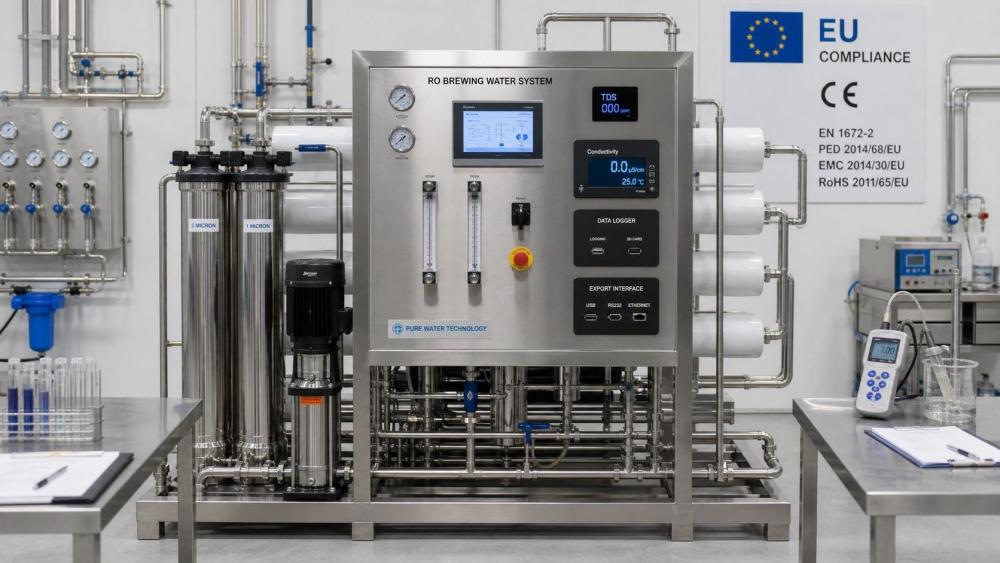
What the new requirement now makes mandatory
According to the provided event summary, the EU Food-Grade Water Treatment Equipment Compliance Notice (Ref. EU-FW/2026/017) became effective on June 28, 2026. From that date, all RO Brewing Water Systems entering the EU market are required to integrate certified real-time TDS and conductivity digital logging modules.
The same requirement also states that the equipment must support at least 90 days of local data storage and CSV export functionality. The information provided further indicates that this requirement directly affects the compliance adaptation progress of Chinese RO system manufacturers exporting to Europe.
The confirmed consequence described in the input is that equipment not upgraded to meet this requirement will not be able to pass the review for CE plus EC 1935/2004 declarations of conformity.
Where the pressure is likely to appear across the business chain
For manufacturers adjusting product configuration
From an industry perspective, the most immediate impact falls on equipment manufacturers whose RO brewing water systems are intended for the EU market. The reason is straightforward: the rule is not framed as an optional monitoring feature, but as a mandatory integrated module requirement linked to conformity review. In practice, the affected business steps are likely to include product design alignment, component selection, firmware or interface preparation, and technical file updates needed for export-ready configurations.
What deserves closer attention is the connection between hardware integration and compliance documentation. Once logging capability, storage duration, and export format become part of review expectations, manufacturers will need to make sure product specifications, declarations, and supporting technical materials describe the configured system consistently.
For exporters and trading companies handling EU-bound shipments
Exporters and trading intermediaries may be affected because shipment readiness now depends not only on the base RO treatment function, but also on whether the system version being sold into the EU includes the required digital logging module. The impact is likely to be concentrated in pre-shipment checking, order confirmation, model matching, and document coordination with buyers or review bodies.
Analysis shows that trade-side risk may arise when product versions for different markets are mixed, or when contract documents and delivered configurations do not clearly reflect the new requirement. For this reason, export teams should pay close attention to model descriptions, configuration sheets, and conformity-related paperwork associated with EU orders.
For buyers, import-side procurement teams, and project delivery
Buyers and procurement teams are also likely to face practical changes, because purchasing decisions for EU-bound applications may now need to include confirmation of certified real-time TDS and conductivity logging, 90-day local storage, and CSV export capability as baseline requirements. The effect is likely to show up in tender specifications, supplier qualification review, acceptance criteria, and delivery scheduling.
Observably, this is not only a technical specification issue but also a procurement control issue. If purchase documents do not reflect the new requirement clearly, there is a higher chance of mismatch between ordered and compliant equipment at the delivery stage.
For certification, testing, and after-sales support participants
Certification-related companies, testing service providers, and after-sales support teams may also see changes in workflow. The requirement is relevant because conformity review under CE and EC 1935/2004 is explicitly mentioned in the provided information. That means supporting parties may need to align more closely around how logging functions, storage capability, and export features are evidenced in technical and compliance materials.
From a service perspective, after-sales teams may also need to pay attention to configuration verification and data-function consistency on delivered systems, especially where EU-bound equipment had previously been supplied without the newly required module.
What companies should watch in the near term
Keep conformity review materials aligned with actual configuration
Analysis shows that one immediate focus should be consistency between the physical system and the compliance file set. Where a system is presented for CE plus EC 1935/2004 declaration review, the documented configuration should match the installed monitoring and logging functions described in the rule summary. Any gap between declared features and delivered features may become a practical compliance problem.
Recheck order documents for EU-destined models
What deserves closer attention is whether quotations, purchase orders, technical specifications, and delivery descriptions for EU market models explicitly reflect the mandatory logging module, storage duration, and CSV export capability. The input does not provide detailed enforcement procedures, so it would be premature to state how each review body will check this in practice. Even so, document alignment is a reasonable near-term priority.
Monitor certification language and execution interpretation
Observably, the event should be understood as a rule now in force, but some execution details may still need continued verification in actual market practice. Companies should therefore watch for how certification language, conformity review expectations, and related technical documentation requirements are expressed in ongoing compliance work. This is especially relevant where product teams, export teams, and external service providers rely on different document versions.
Factor compliance adaptation into delivery planning
From an industry perspective, companies involved in EU-bound RO brewing water systems should also pay attention to delivery sequencing and upgrade readiness. The input confirms that non-upgraded equipment cannot pass the relevant conformity review, which means compliance adaptation has a direct connection to shipment planning and customer delivery commitments. Where transition work is still underway, the practical issue is less about broad strategy and more about whether product readiness, paperwork, and supply arrangements move in step.
Why this looks like an execution signal rather than a distant policy discussion
Analysis shows that this development is better understood as an active market-access requirement than as a preliminary policy direction. The event has a stated effective date, identifies the product scope, and links the new requirement directly to conformity review outcomes. That combination makes it more than a general compliance trend.
At the same time, it is also appropriate to treat this as a rule whose implementation details still deserve observation. The provided information does not include fuller procedural guidance, model-by-model interpretation, or examples of review practice. For that reason, the industry should continue to monitor how the requirement is reflected in certification handling, procurement language, and customer acceptance expectations.
How this update is best understood now
The most balanced reading of this event is that the EU has introduced a concrete compliance threshold for RO brewing water systems entering its market, centered on certified real-time TDS and conductivity digital logging, 90-day local storage, and CSV export capability. For affected businesses, the issue is not only technical modification but also documentation consistency, procurement alignment, and delivery readiness.
Current observation suggests that this should be treated as a landed compliance change with direct export implications, while some execution details still warrant continued tracking. In that sense, the immediate task for companies is not broad market speculation, but disciplined alignment between product configuration, conformity materials, and EU-bound order handling.
Basis of this report and what still needs verification
This article is based on the user-provided news title, event date, and event summary. Typical source types relevant to developments of this kind may include official notices, regulatory authority publications, customs or trade administration updates, industry association releases, standards documents, and reporting by established trade media. No specific official source link was provided in the input, so the exact official link still needs to be verified on an ongoing basis.
Further observation is still needed on detailed implementation language, conformity review interpretation, tender document changes, market feedback, and how affected companies complete compliance adaptation in practice.
Related News
- 00
0000-00
Contamination Control in Fermentation: Building a CIP and Sampling Plan That Works - 00
0000-00
How to Evaluate a Keg Dispensing Systems Supplier for Multi-Tap Draft Operations - 00
0000-00
How Isobaric Filling Technology Protects Beer Carbonation and Reduces Oxygen Pickup - 00
0000-00
How to Specify Bottle Filling Lines for Carbonated Drinks Without Sacrificing Fill Accuracy - 00
0000-00
How to Specify Turnkey Brewery Automation for Consistent Batch Quality and Labor Savings
Weekly Insights
Stay ahead with our curated technology reports delivered every Monday.